

Packaging
This is paragraph text. Click it or hit the Manage Text button to change the font, color, size, format, and more. To set up site-wide paragraph and title styles, go to Site Theme.
| :yuck | Size | Product number | Packaging | m2 |
|---|---|---|---|---|
| 25 | 600x1200 |
Technical information
Volume weight
In Iceland, three densities of EPS insulation are mainly produced, 16 kg/m³, 24 kg/m³ and 30 Kg/m³. It is also possible to obtain plastic with a higher density, for example if increased pressure resistance is desired, but the strength of EPS increases with increased density.
Thermal conductivity
The lower the thermal conductivity value of a material, the better thermal insulation the material provides.
The thermal conductivity is measured regularly in a perfect thermal conductivity measuring device in accordance with ÍST-EN 12667 and ÍST-EN 12939, at a reference temperature of 10°C. The stated values are increased from the measured values taking into account the standard deviation of repeated measurements and the number of measurements that have been made in accordance with ÍST-EN 13163.
The figure on the left shows how the thermal conductivity (λ) depends on the density of the foam.
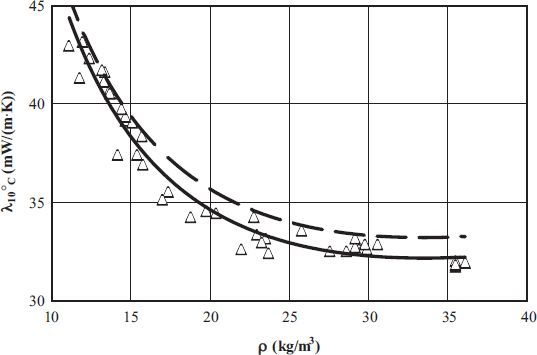
Heimild: Gnip o.fl. 2012. Thermal conductivity of expanded polystyrene (EPS) at 10 °C and its conversion to temperatures within interval from 0 to 50 °C. Energy and Buildings 52:107-111.
Atrophy and post-atrophy
Shrinkage of the insulation block can be up to 1% immediately after production. Post-shrinkage is the shrinkage measured after 24 hours, when the excess expansion agent evaporates from the cast insulation block. This factor can last from one day to several weeks, depending on the density to volume ratio. Insulation plastic can shrink by 3mm/m² (< 0.3%) in the first 6 weeks, which is insignificant, but on a large continuous surface it can have a slight effect.
After 6-8 weeks at the correct storage temperature, there will be no shrinkage of insulating plastic from Tempra ehf.
The effect of humidity
Most materials are "hygroscopic", i.e. they absorb moisture from the air surrounding them. The relationship between air humidity and material humidity is important when assessing their insulating ability in normal use, but thermal conductivity is only known for dry materials. The thermal conductivity of water of 0.55 - 0.58 w/mk is approximately twenty-five times greater than the thermal conductivity of air, which is 0.024 w/mk, and it is therefore natural that moist materials conduct better than dry materials. With increasing humidity, the conductivity of most materials increases. The actual value of lp above is based on a moisture content of 2% of the weight of the insulation. EPS insulation of 16 kg/m³ has a moisture content of around or less than 0.1% of its weight from the factory. Its thermal conductivity generally increases by 0.3% for every 1% increase in moisture content, or from 0.037 w/m² °C to 0.0371 w/m² °C. However, the moisture absorption of EPS insulation is insignificant compared to many other insulation materials. EPS insulation, which is 18 kg/m³, for example, only absorbs water equivalent to 0.1 - 0.4% of its volume when floating in +20°C hot water for one day.
Comparison of some common insulation materials
The graph below shows the effect of increased humidity on the thermal conductivity of rock wool, glass wool and EPS insulation, as well as a simplified diagram showing the relative humidity of different building materials. Keep in mind that EPS insulation, which is 18 kg/m³, only absorbs water equivalent to 0.1 - 0.4% of its volume when floating in +20°C hot water for one day. The thermal conductivity of water, 0.55 - 0.58 w/mk, is approximately twenty-five times greater than the thermal conductivity of air, which is 0.024 w/mk, and it is therefore natural that moist materials conduct better than dry materials. With increasing humidity, the conductivity of most materials increases.
Strength
Insulating plastic is light and easy to handle, but still has considerable strength. The compressive strength of 16 kg/m³ EPS insulation is about 80 Kpa (8 tons per square meter), while if the density is 24 kg/m³ the compressive strength reaches about 140 Kpa (14 tons per square meter). The compressive strength is based on the material compressing by 10% under the load.
Because of its high compressive strength, EPS insulation is well suited to use where loads are high, for example on plinth walls and under floor slabs. The flexural tensile strength of EPS insulation comes in handy in various situations and can, for example, easily become part of the structural structure, thereby significantly lightening it with associated material savings.
Usage
Working with insulating plastic is very convenient. The material is light and can be easily cut with a knife or saw. No dust is generated when using the material, and special protective clothing is therefore unnecessary. The plastic will not deform when used from -180°C - 80°C. It is necessary to protect the plastic with, for example, a plaster coating or similar materials in accordance with Article 135.10 of the Building Regulations on Fire Protection and Fire Safety. Insulating plastic is placed under cement-based masonry or masonry systems as thermal insulation both inside and outside of external walls. Insulation under external masonry must have good moisture resistance. It must not be water-absorbent, as it can draw water from the masonry and thus even increase moisture transfer. Under special circumstances, damp insulation can freeze with unforeseen consequences or become as hot as 50-60°C due to solar radiation if the masonry is dark in color. Stresses due to heat, cold and humidity can therefore be significant and should be taken into account when designing.
EPS insulation should therefore be a good choice for designers in most situations, especially when considering its resistance to moisture.

Examples of places of use:
Always follow the drawings and instructions for the building being worked on.
Insulating plastic on top of a concrete ceiling slab (slatted roof)
On top of the concrete ceiling slab, 175 mm of roof insulation is used, which is composed of 150 mm of insulating plastic and 25 mm of fire protection. The insulating plastic is staggered so that no cold conduction occurs.
Insulating plastic for underfloor heating in apartment buildings
The underfloor heating pipes are laid on top of the insulating plastic so that it does not create radiant heating on the floor below.
Insulating plastic on top of a concrete ceiling slab
Insulating plastic for concrete roofs is cut into strips to form a water slope. The insulating plastic is double-layered. It is covered with roofing felt.
Insulating plastic in precast units
Insulation is widely used in precast units. The insulation is either placed in the middle of the wall or on the outside.
Insulating plastic as interior insulation
This traditional method of interior insulation has been around for 40 years. If the insulation boards are fixed with dowels, very good sound insulation is achieved.
Insulating plastic as exterior wall insulation
When insulating on the outside, 100 mm insulation plastic is most often used. Concrete savings are 22% if the outer wall is kept 14 cm thick instead of 18 cm.
Insulating plastic as plinth and baseboard insulation
75 mm insulation plastic is often used. Insulation plastic has a moisture resistance value 50 times higher than other comparable insulation materials used in these conditions.
EPS and brownie
Since EPS insulation is a petroleum product, it is susceptible to fire. EPS plastic can be made flame retardant, and its autoignition temperature is 497 degrees Celsius, which is slightly higher than the autoignition temperature of wood. When EPS insulation is used indoors, it should be protected with a flame retardant material, such as plaster at least 3 cm thick. Burning EPS insulation at high temperatures and with sufficient oxygen flow (such as in an incinerator) produces less smoke and toxins than burning wood. As with all combustion, carbon dioxide, CO2, is produced, but the flow of oxygen affects how much CO is produced.
It is necessary to protect the plastic with, for example, plaster or similar materials in accordance with section 135.10 of the Building Code on Fire Prevention and Fire Safety.
Research on insulating plastic under exterior walls
A total of 93 buildings were selected for the study with regard to size, type and geographical location in relation to wind load and temperature. The study was carried out by the Holzkirchen Branch of the Fraunhofer Institute of Physics in Germany. In all cases where the condition of the insulating plastic was examined, no damage, decay, shrinkage or deformation was measured after up to 20 years of use. The insulating plastic met all requirements for insulating materials according to DIN 18164. The moisture content in the insulating plastic was measured in both single-family and industrial buildings and was found to be less than the requirements for insulating plastic. A total of 93 buildings were selected for the study with regard to size, type and geographical location in relation to wind load and temperature. The study was carried out by the Holzkirchen Branch of the Fraunhofer Institute of Physics in Germany. In all cases where the condition of the insulating plastic was examined, no damage, decay, shrinkage or deformation was observed after up to 20 years of use. The insulating plastic met all requirements for insulating materials according to DIN 18164. The moisture content in the insulating plastic was measured in both single-family and industrial buildings and was found to be less than the requirements for insulating plastic.
The investigative committee's report mentioned that about 20% of the houses studied had been repaired in some way after 11 years of use, mainly by painting.
The final report specifically states that the moisture content measured was an absolute minimum of 0.06%. Research was conducted on these houses again after 8 years and the research showed that the insulation was in perfect condition. The results achieved with these measurements are unequivocal proof that insulation is a good option for insulation under exterior walls.
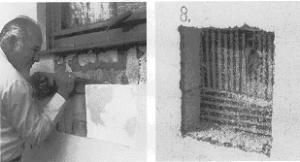
| Sample No. 8 | |
|---|---|
| Age: | 10 years old |
| Rakainnihald: | 0,021% |
| Insulation thickness: | 100 mm |
| Space weight: | 16 kg/m3 |
Research into the durability of roof insulation
The results of studies conducted on insulating plastic under roofing felt on a flat roof built in 1955 in Germany (i.e. 31 years old, 1986) show the following results. The insulation panels lay tightly together at the joints and were in the same condition as when they were laid down 31 years ago, i.e. no shrinkage, decay or changes in shape had occurred.The results of studies conducted on insulating plastic under roofing felt on a flat roof built in 1955 in Germany (i.e. 31 years old, 1986) show the following results:
The insulation boards lay tightly together at the joints and were in the same condition as when they were laid down 31 years ago, i.e. no shrinkage, decay or change in shape had occurred.
Many samples were taken from this roof and sent for further analysis to the Munich Research Institute (Forschungsinstut für Wärmeschutz, Munich). The following aspects were examined: 1. Thermal conductivity 2. Moisture content
Conclusion:
- The result of the thermal conductivity of the insulating plastic on the roof in question, measured according to DIN 52612, was found to be 0.0345 w/m2 °k and a density of 17.4 kg/m3 (measurement result no.: F.2 - 351/86 d.16.10.1996)
- The moisture content measured only 0.2% after 31 years
The results are unequivocal, all samples taken were found to be undamaged after 31 years and met all requirements for building materials in Germany according to DIN 18164.
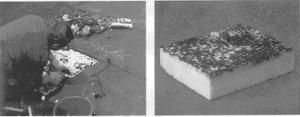
One of the many samples taken from the roof after 31 years and meeting all the requirements for EPS as an insulation material.
Acoustic measurements by the Construction Industry Research Institute
In recent years, there has been a growing discussion about increased sound requirements in residential buildings. In collaboration with the Building Industry Research Institute, sound measurements were carried out on different insulation boards in the Rb sound studio, and the project was funded by the Housing Loan Fund.In recent years, there has been a growing discussion about increased sound requirements in residential buildings. In collaboration with the Building Industry Research Institute, sound measurements were carried out on different insulation boards in the Rb sound studio, and the project was funded by the Housing Loan Fund.
The following insulation panels were soundproofed:
- Insulation plastic 16 kg/m3 100 mm, glued with masonry adhesive 20 mm masonry
- Soundproofing 100 (manufactured by Tempra hf) 100 mm, fixed with dowels 20 mm masonry
- Insulation plastic 16 kg/m3 100 mm, fixed with dowels 20 mm masonry
- Rock wool 100 mm wallboard (80 kg/m3), fixed with dowels 20 mm wall
Sound measurement results:
Based on a 125 mm concrete wall Rw Rw C50-500 Rw8dB = la
- Insulating plastic, glued on 45 44 42
- Sound insulation 100, fixed with dowels 58 53 56
- Insulating plastic, fixed with dowels 53 52 53
- Rock wool (wallboard), fixed with dowels 53 51 53
It is interesting to note in these measurements that the sound insulation in measurement no. 3 (insulation plastic fixed with dowels) and measurement no. 4 (rock wool fixed with dowels) are measured to have equally good sound insulation, but Sound Insulation 100 is measured to have the best sound insulation!
Certificates/declarations for insulation:
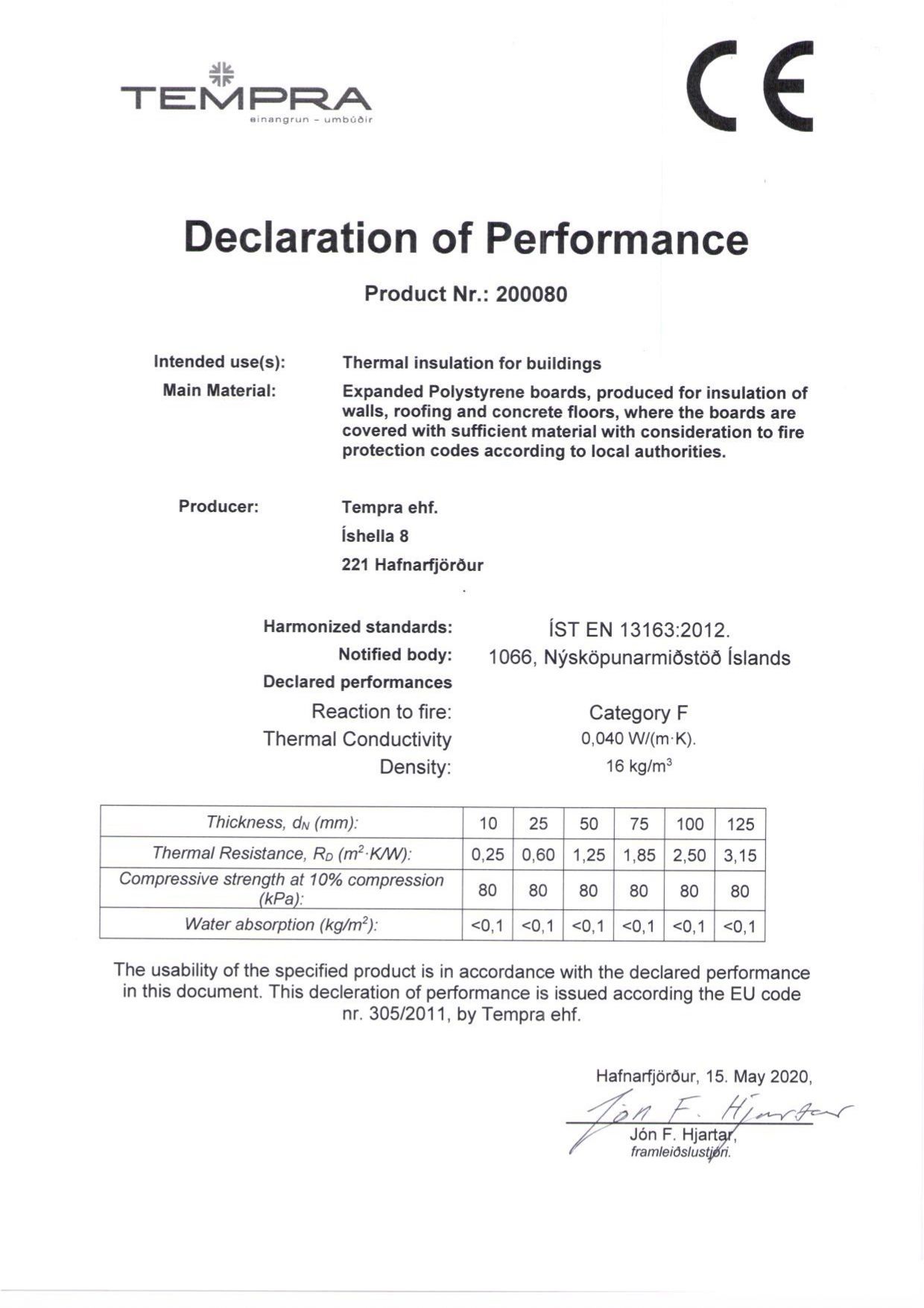
Declaration of Conformity No. 200080
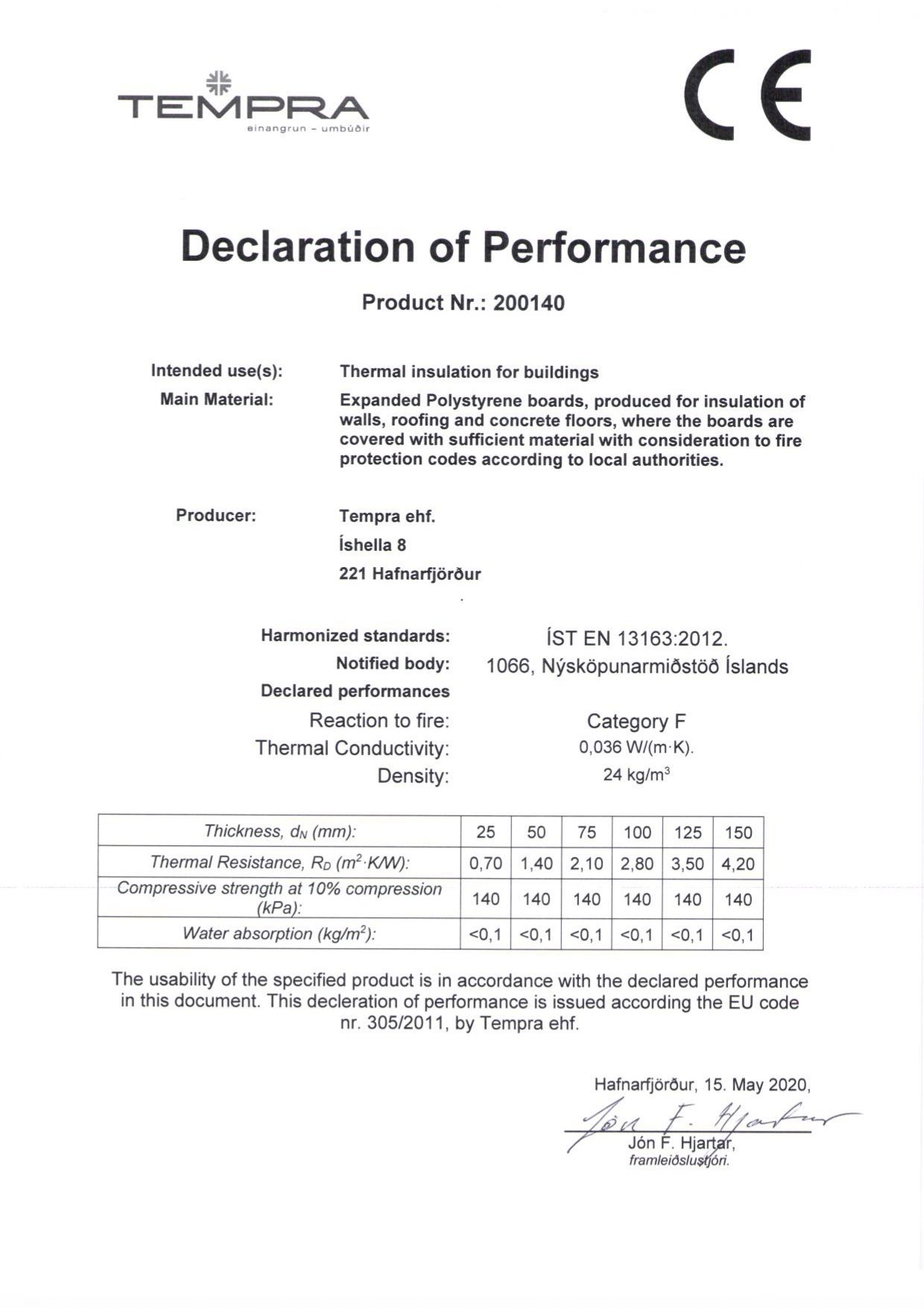
Declaration of Conformity No. 200140
View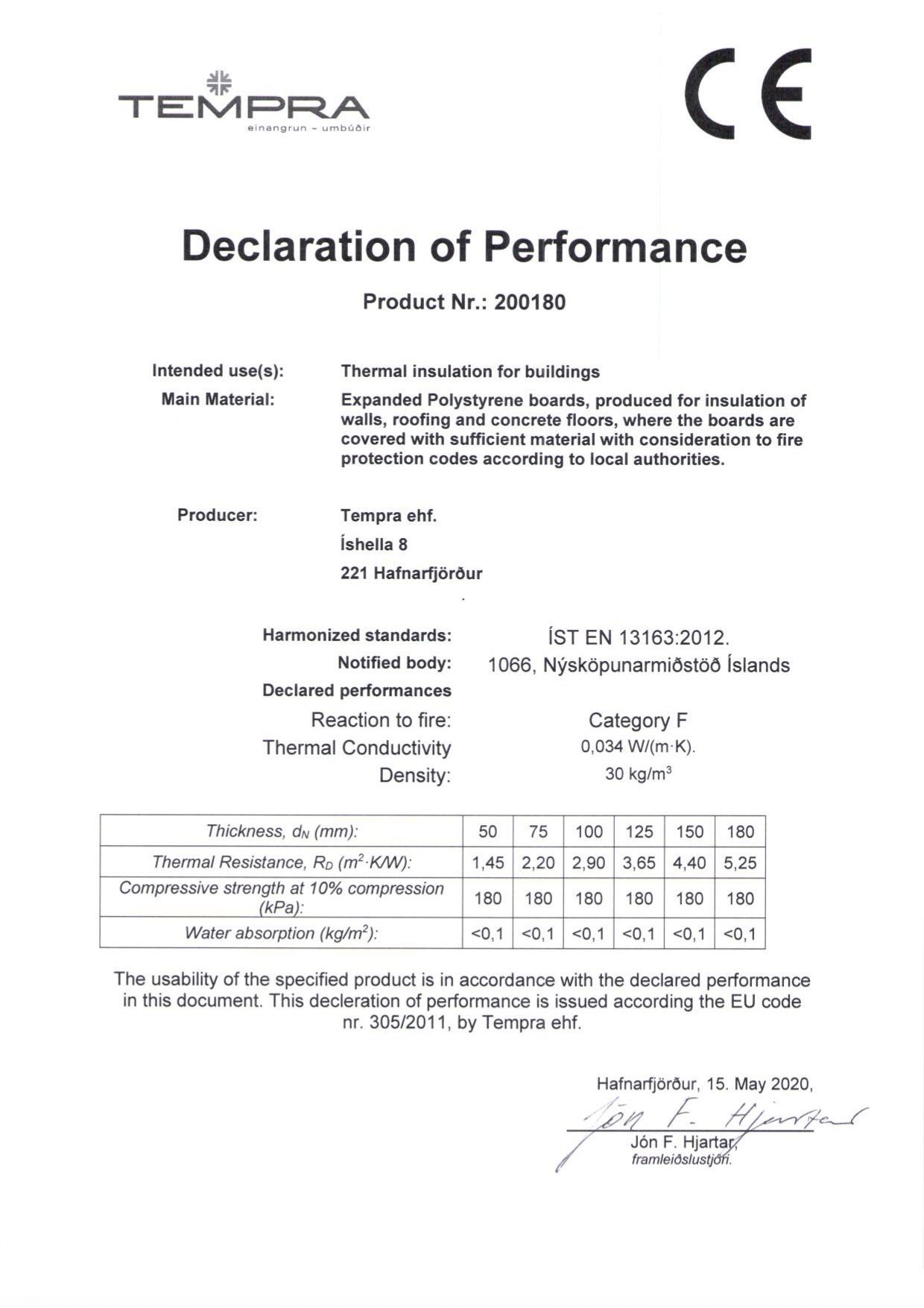
Declaration of Conformity No. 200180
View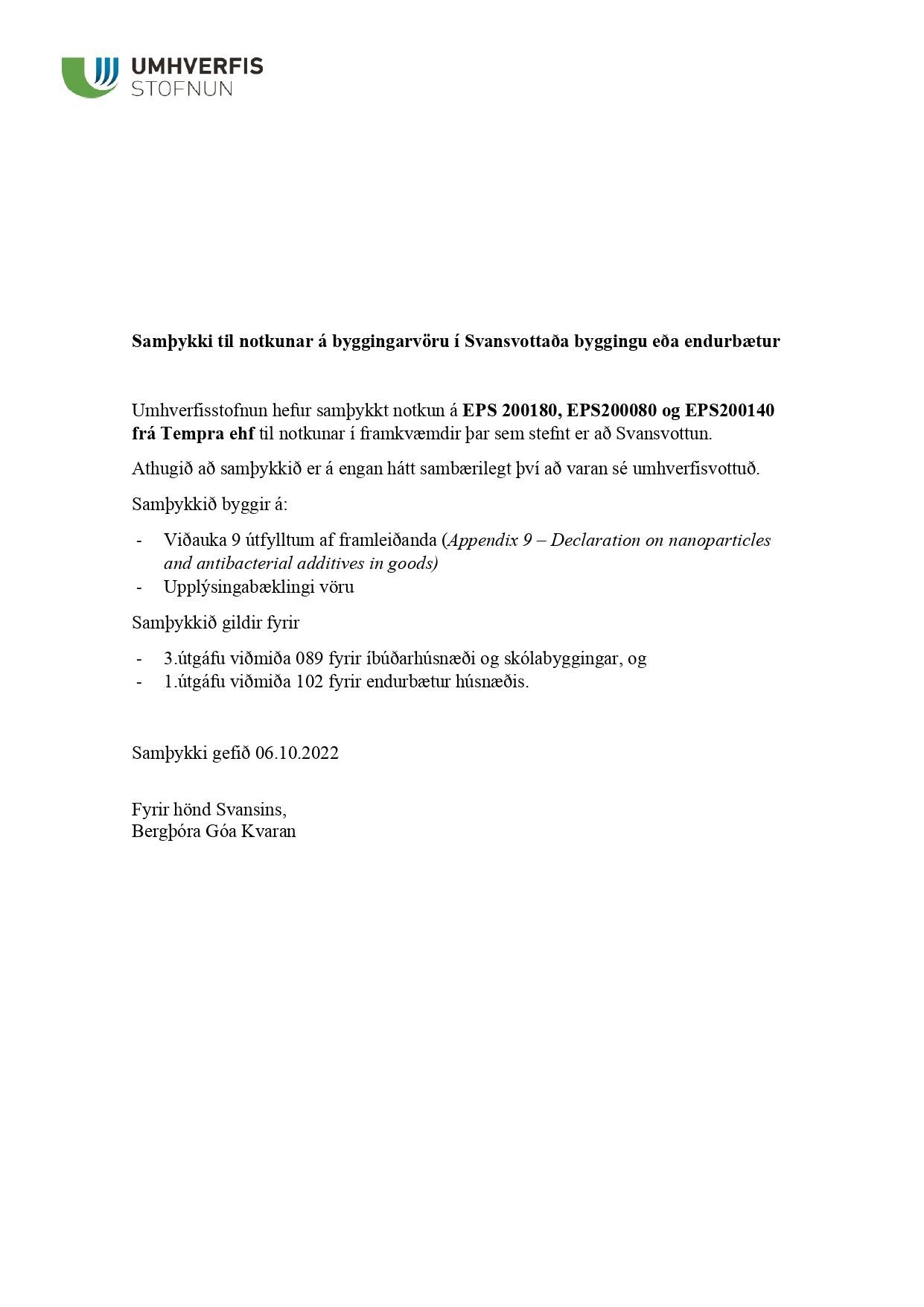
Approval from the Icelandic Environmental Protection Agency for use in Nordic Ecolabel-certified buildings or renovations EPS insulation
View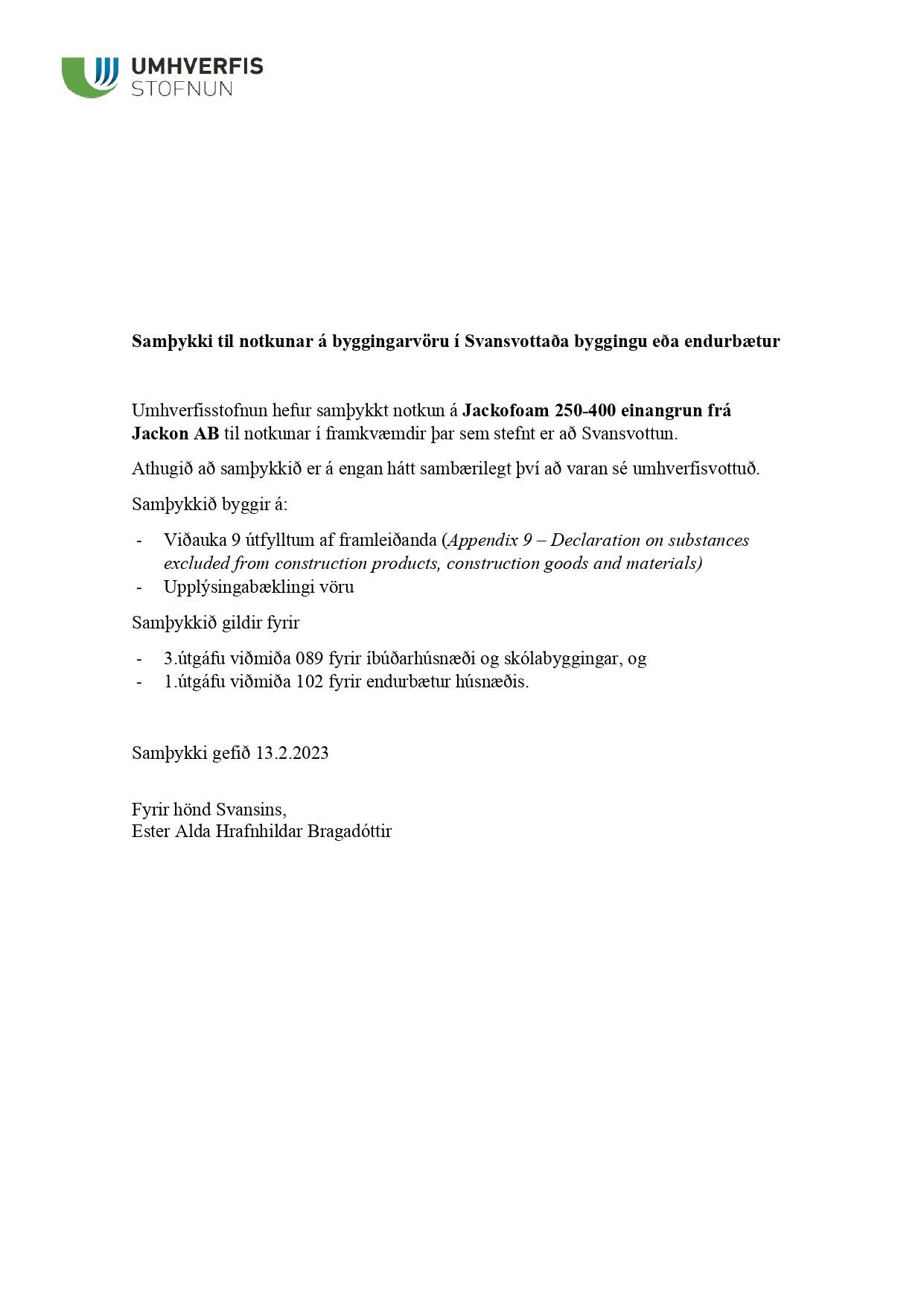
Approval from the Icelandic Environmental Protection Agency for use in Nordic Ecolabel-certified buildings or renovations XPS Insulation
View